How Customers Find Nearby Businesses Online
Introduction
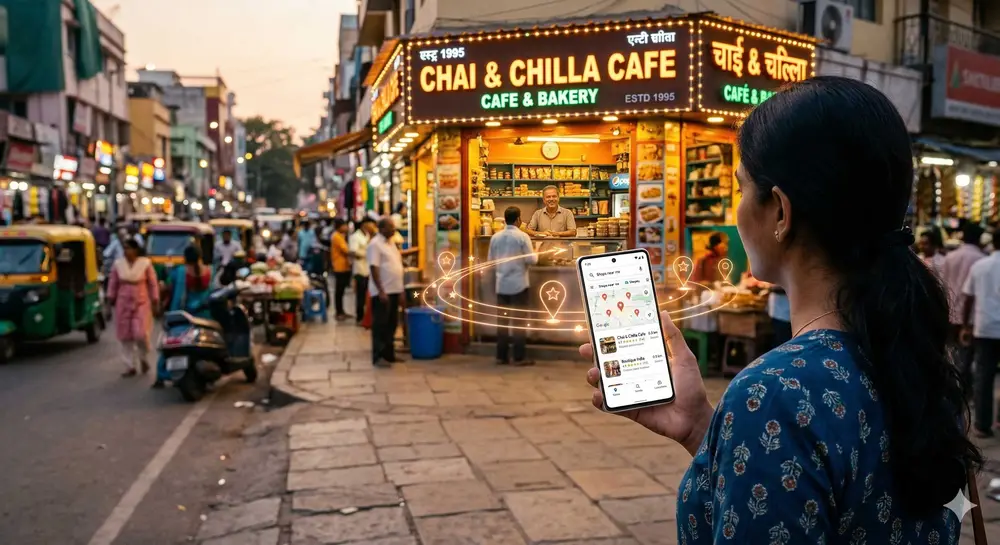
Many local business owners in India believe that customers will automatically find them if the shop is good or the service is honest. While quality is important, customer discovery has changed. Today, most customers do not walk around to explore options. They search online first. They use their phones to find nearby shops, services, and professionals. This change affects every local business, whether it is a small store, a clinic, a service provider, or a coaching centre. If you understand how customers find nearby businesses online, you can position your business correctly. If you do not, you may lose customers without realising why. This shift is also explained in our guide on why local search is important for small businesses in India.
Understanding How Online Discovery Works
Online discovery is the process through which customers search, compare, and choose a nearby business using the internet.
This usually happens before:
- Visiting a shop
- Calling a service provider
- Asking for directions
- Making a booking
Customers want convenience. Online discovery helps them reduce effort and uncertainty. This behaviour is closely linked to local search for small businesses, where location and relevance matter most.
The Typical Customer Journey for Nearby Business Search
To understand this better, let us look at the step-by-step journey most customers follow.
Step 1: A Need Arises
The journey starts when a customer has a need.
Examples:
- A phone stops working
- A child needs tuition
- A vehicle needs repair
- Someone falls sick
- A household service is required
This need may be urgent or planned.
Step 2: The Customer Searches Online
Instead of asking many people, customers now search online.
Common search phrases include:
- “Near me”
- “In my area”
- “Open now”
- “Best nearby”
This behaviour is very common across India and is one of the main drivers behind local business growth in the digital age.
Step 3: The Customer Scans Results Quickly
Customers do not read everything. They scan.
They look at:
- Business name
- Location
- Distance
- Timings
- Reviews (if available)
If information is missing or confusing, they skip the business. This is why accurate business listings matter for local search.
Step 4: Shortlisting and Contact
From the results, customers usually shortlist:
- 1–3 nearby options
Then they:
- Call
- Visit
- Send a message
- Ask for directions
The business that looks easiest and most trustworthy often gets chosen.
Where Customers Search for Nearby Businesses
Customers do not use only one platform. They use multiple digital touchpoints.
1. Search Engines
Search engines are often the first step.
Customers type simple queries like:
- “Doctor near me”
- “Laptop repair nearby”
Search engines show location-based results. This is how nearby searches convert into real customers for local businesses.
2. Maps and Navigation Apps
Many customers use map-based search to:
- Find distance
- Check directions
- See if a business is open
Map visibility is very important for walk-in businesses, especially in busy city areas.
3. Local Business Discovery Platforms
Customers also use local business discovery platforms that organise businesses by:
- City
- Area
- Category
- Services
These platforms help customers compare nearby options easily. Many users explore category-based local business listings to shortlist services.
4. Social Proof and Reviews
Even after finding a business, customers often check:
- Reviews
- Ratings
- Feedback
This helps them feel confident before contacting. The role of reviews is explained further in why customer reviews help local businesses grow.
Why Being “Nearby” Matters More Than Being “Popular”
Most customers prefer convenience over popularity.
For example:
- A good clinic nearby is preferred over a famous clinic far away
- A trusted repair shop close by is better than a popular one across town
This is why proximity plays a big role in online discovery, especially for local service providers near you.
How Search Systems Think (In Simple Terms)
Search systems try to show:
- Relevant businesses
- Nearby businesses
- Trustworthy businesses
They look at:
- Location accuracy
- Business category
- Consistency of information
- User engagement
Businesses with clear and updated information are favoured over those with confusion or gaps.
Common Discovery Patterns in India
Urban Areas
In cities:
- Customers compare multiple options
- Reviews matter more
- Speed and convenience are important
Tier 2 and Tier 3 Cities
In smaller cities:
- Customers trust nearby known areas
- Availability matters more than branding
- Simplicity wins
A shop or clinic in cities like Indore or Guwahati can benefit greatly from clear online discovery. This trend is covered in our city-based local business growth guides.
Rural and Semi-Urban Areas
Even in semi-urban areas:
- Smartphone search is increasing
- Customers look for the nearest available option
- Digital discovery is growing steadily
Why Many Local Businesses Are Not Found Online
Despite being good businesses, many are not discovered online.
Common reasons include:
- No online presence
- Incorrect address or phone number
- Wrong category selection
- Outdated timings
These small issues completely block discovery, even if demand exists.
Step-by-Step: How Businesses Can Align With Customer Discovery
Step 1: Be Clear About What You Offer
Customers must understand quickly:
- What you do
- Who you serve
- Where you are located
Confusion leads to rejection.
Step 2: Make Location Easy to Understand
Your area, landmark, and accessibility should be clear.
Customers often avoid businesses if they are unsure how to reach them.
Step 3: Keep Information Updated
Timings, phone numbers, and services should always be current.
Outdated information breaks trust and reduces repeat enquiries.
Step 4: Support Trust Signals
Even simple trust signals help:
- Clear descriptions
- Honest reviews
- Consistent presence
Trust helps customers choose faster.
The Role of Local Discovery Platforms
Local discovery platforms organise nearby businesses in a structured way.
They help customers:
- Find services quickly
- Compare nearby options
- Discover businesses they did not know before
For businesses, they provide visibility without heavy marketing pressure. Platforms like SearchKoro act as neutral discovery spaces where local customers can find nearby services and products easily.
Long-Term Benefits of Understanding Customer Discovery
Businesses that understand customer discovery:
- Get more relevant enquiries
- Waste less effort on wrong marketing
- Build steady visibility
- Stay relevant as behaviour changes
This understanding becomes a long-term advantage.
Preparing for the Future of Local Discovery
In the coming years:
- Online discovery will increase
- Competition will rise
- Visibility gaps will widen
Businesses that align early with customer behaviour will find growth easier and calmer.
Conclusion
Customers today find nearby businesses online through search, maps, and local discovery platforms. They look for convenience, clarity, and trust. For Indian local businesses, understanding this discovery process is very important. It helps businesses become visible at the right moment and connect with nearby customers naturally. Online discovery is not about technology. It is about meeting customers where they already are.