


Best Physiotherapy Exercises for Lower Back Pain: 2026 Guide
Lower back pain affects up to 80% of people at some point in their lives, and it is one of the leading causes of missed work days worldwide. As more people sit for long hours and move less, this nagging ache or sharp spasm in the lower back can quickly turn into a chronic problem that limits daily life.
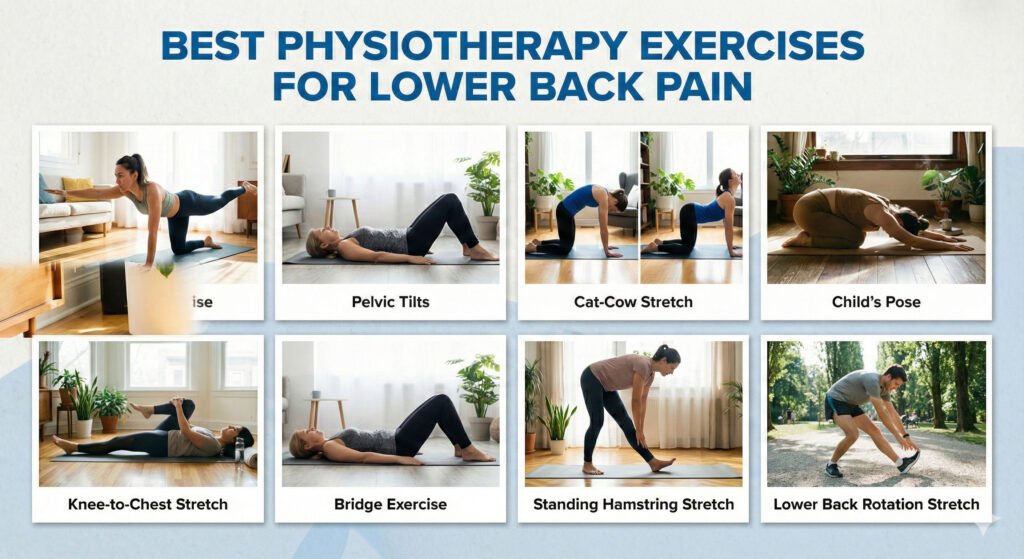
However, the good news is that targeted physiotherapy exercises can relieve pain, improve mobility, and strengthen the muscles that support your spine. Instead of random stretches found on social media, a structured, evidence-informed routine helps you move safely and consistently towards long-term relief. In this 3000+ word guide, you will learn exactly which movements physiotherapists commonly recommend, how to perform them step by step, and when it is time to stop exercising and see a professional.
In this post, you will learn:
-
How physiotherapy exercises help lower back pain and prevent future flare-ups.
-
The best beginner-friendly physiotherapy exercises for lower back pain at home.
-
A simple progression plan to safely increase intensity over several weeks.
-
Common mistakes and unsafe back exercises you should avoid.
-
When to stop self-treatment and consult a physiotherapist or doctor immediately.
What Causes Lower Back Pain?
Lower back pain often develops due to a combination of muscle strain, poor posture, weak core muscles, and age-related changes in the spine. In many modern lifestyles, long hours of sitting compress the discs and weaken supporting muscles, which makes the lower back more vulnerable to even simple movements like bending or lifting.
Moreover, conditions such as herniated discs, spinal stenosis, and osteoarthritis can contribute to chronic lower back pain, especially in people over 40. In addition, sudden injuries, sports overload, or lifting heavy objects with poor technique can trigger acute episodes that may settle but then recur if the underlying weakness is not addressed.
Common Everyday Triggers
Many people notice stiffness or pain after sitting in front of a computer, driving long distances, or sleeping on an unsupportive mattress. Furthermore, habits like bending from the waist to pick up objects, carrying heavy bags on one side, or wearing unsupportive footwear add daily strain to the lumbar spine.
In addition, stress and poor sleep can make the nervous system more sensitive, which means mild mechanical problems feel more painful than they otherwise would. Therefore, effective physiotherapy for lower back pain looks not only at exercises but also at posture, ergonomics, and lifestyle triggers.
When Lower Back Pain Becomes Chronic
Lower back pain is considered chronic when it persists for more than 12 weeks, even if the intensity fluctuates. In many cases, the original tissue injury has healed, but the muscles remain weak, stiff, or poorly coordinated, so normal movements still feel risky and painful.
Consequently, people may avoid exercise altogether, which further reduces strength and flexibility and keeps the pain cycle going. Therefore, graded physiotherapy exercises help break this cycle by gently rebuilding capacity and confidence in movement.
Why Physiotherapy Exercises Matter
Physiotherapy exercises target the muscles, joints, and nerves that support the lower back, helping to reduce pain, improve function, and prevent recurrences. In particular, strengthening the deep core and gluteal muscles reduces the load on the spinal joints and discs during daily activities.
Additionally, stretching tight hip flexors, hamstrings, and lower back muscles can ease tension and improve posture, which is critical for people who sit for most of the day. Unlike passive treatments alone, such as massage or heat, active physiotherapy exercises give you tools to manage mild to moderate lower back pain yourself.
How Exercise Supports Spine Health
Specific exercises like pelvic tilts, cat-cow, and bridges work together to stabilize and mobilize the lumbar spine. For example, pelvic tilts activate the abdominal muscles and gently flatten the lower back against the floor, which can reduce pain and retrain your posture.
Similarly, cat-cow and child’s pose sequence help to restore spinal flexibility while relaxing tight back muscles. As a result, regular practice of these physiotherapy exercises improves blood flow, reduces stiffness, and supports long-term spine health.
Evidence and Research on Exercise for Back Pain
Clinical guidelines for non-specific lower back pain consistently recommend exercise-based rehabilitation as a first-line treatment in most cases. Studies show that structured exercise therapy can reduce pain, improve function, and lower the risk of recurrent episodes compared with rest alone.
In addition, supervised physiotherapy programs often combine strengthening, stretching, and education, which appears more effective than isolated approaches. Therefore, even if you start with home exercises, consulting a physiotherapist for a personalized plan can further improve outcomes.
How to Use This Exercise Guide Safely
Before starting, it is important to understand that not every lower back pain pattern is suitable for self-directed exercise. If you have severe, unexplained pain, recent trauma, or underlying medical conditions such as cancer or significant osteoporosis, you should seek medical advice first.
Furthermore, begin with gentle movements and listen carefully to your body; mild stretching discomfort is acceptable, but sharp, shooting, or worsening pain is a signal to stop. In addition, move slowly, control your breathing, and avoid bouncing or jerky movements that may irritate sensitive tissues.
Who Should Not Start Without Medical Advice
You should consult a doctor or physiotherapist before starting these exercises if you have:
-
Pain following a significant fall or accident.
-
Sudden loss of bladder or bowel control, or numbness in the groin area.
-
Progressive weakness, numbness, or tingling in one or both legs.
-
History of cancer, unexplained weight loss, or fever along with back pain.
These “red flag” symptoms may indicate a serious condition that needs urgent assessment rather than home exercises.
Warm-Up and General Safety Rules
Before you perform the specific physiotherapy exercises, spend 5–10 minutes walking, marching in place, or doing gentle dynamic movements for your hips and spine. This light warm-up increases blood flow and prepares your muscles and joints for stretching and strengthening.
During each exercise, breathe steadily and avoid holding your breath, because breathing helps your muscles relax and improves stability. Additionally, start with 1 set of 8–10 repetitions and gradually build up to 2–3 sets as your pain decreases and strength improves.
Best Physiotherapy Exercises for Lower Back Pain (Beginner)
The following exercises are commonly recommended by physiotherapists for people with mild to moderate lower back pain, especially in the early recovery phase. Always perform them slowly and within a comfortable range of motion.
Pelvic Tilts
Pelvic tilts are a gentle way to activate your abdominal muscles and support the lower back.
-
Lie on your back with knees bent and feet flat on the floor, hip-width apart.
-
Inhale, then as you exhale, tighten your abdominal muscles and press your lower back into the floor, tilting your pelvis slightly towards your ribs.
-
Hold for about 5 seconds while breathing normally, then relax back to neutral.
-
Repeat 10–15 times, once or twice per day.
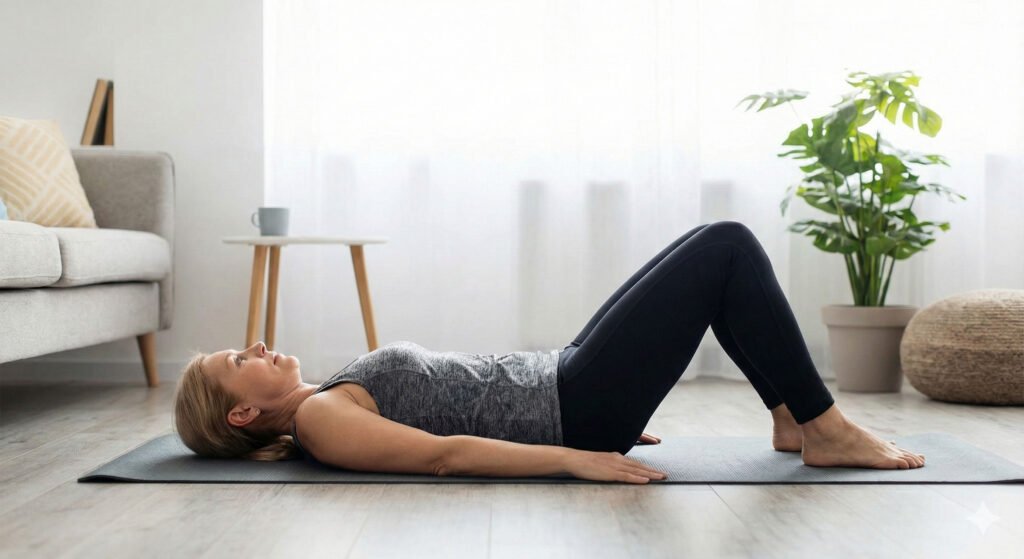
This exercise can reduce stiffness and gently teach your spine to stay in a more neutral, supported position.
Cat-Cow Stretch
Cat-cow improves spinal mobility and eases muscle tension along the entire back.
-
Start on your hands and knees in a tabletop position, with hands under shoulders and knees under hips.
-
Inhale as you gently arch your back, lifting your head and tailbone (cow position).
-
Exhale as you round your spine towards the ceiling, tucking your chin and pelvis (cat position).
-
Move slowly for 10–15 repetitions, synchronizing the movement with your breath.
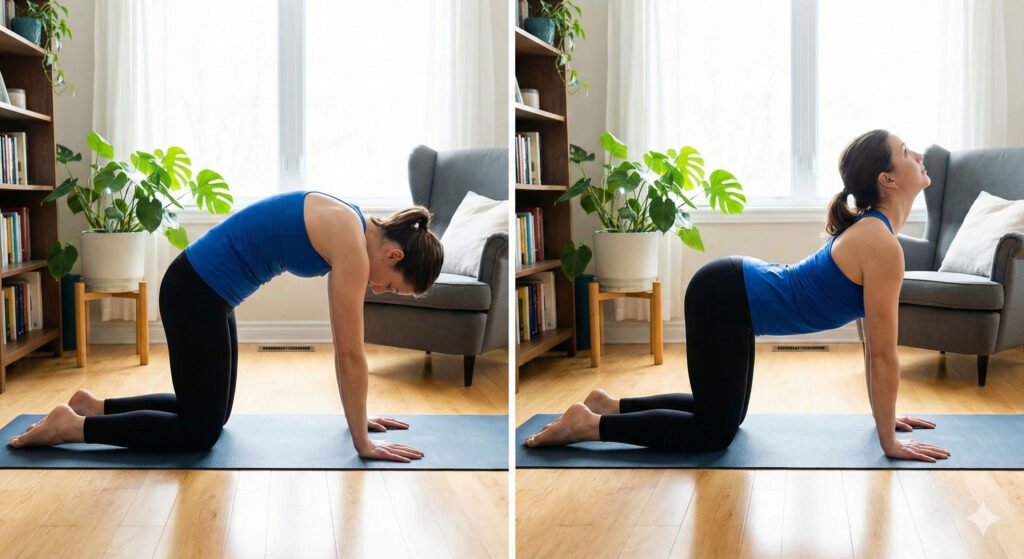
For many people, this rhythmical motion can reduce stiffness from prolonged sitting or standing.
Child’s Pose
Child’s pose is a relaxing stretch that targets the lower back, hips, and thighs.
-
Begin on your hands and knees, then sit your hips back towards your heels, extending your arms forward on the floor.
-
Gently lower your chest towards the ground until you feel a comfortable stretch in your lower back.
-
Hold for 20–30 seconds, breathing slowly, and repeat 3–5 times.
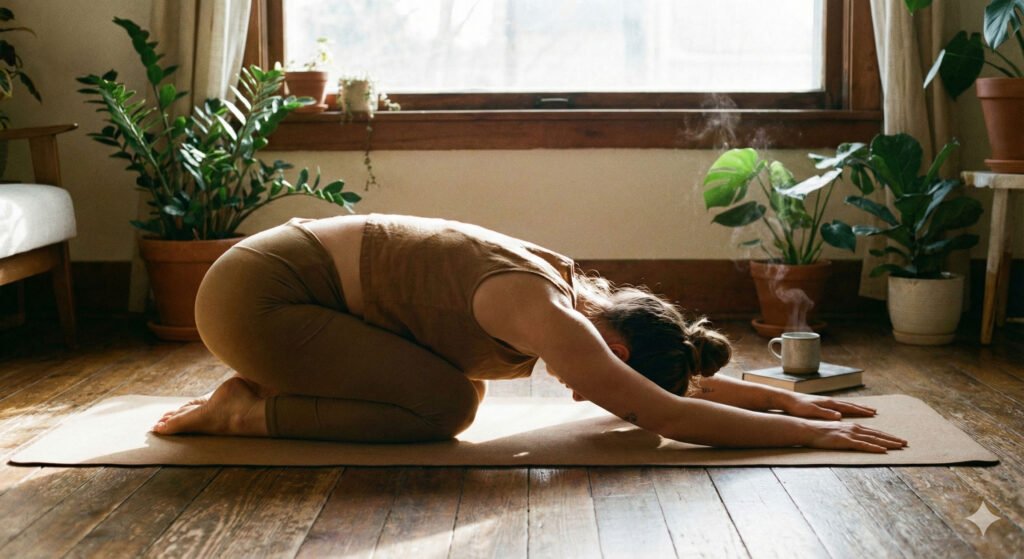
This position can be especially soothing after a long day of standing or walking.
Knee-to-Chest Stretch
The knee-to-chest stretch lengthens the lower back muscles and glutes.
-
Lie on your back with knees bent and feet flat on the floor.
-
Bring one knee towards your chest, holding it with both hands below the knee.
-
Hold for 20–30 seconds, then switch legs, repeating 3 times per side.
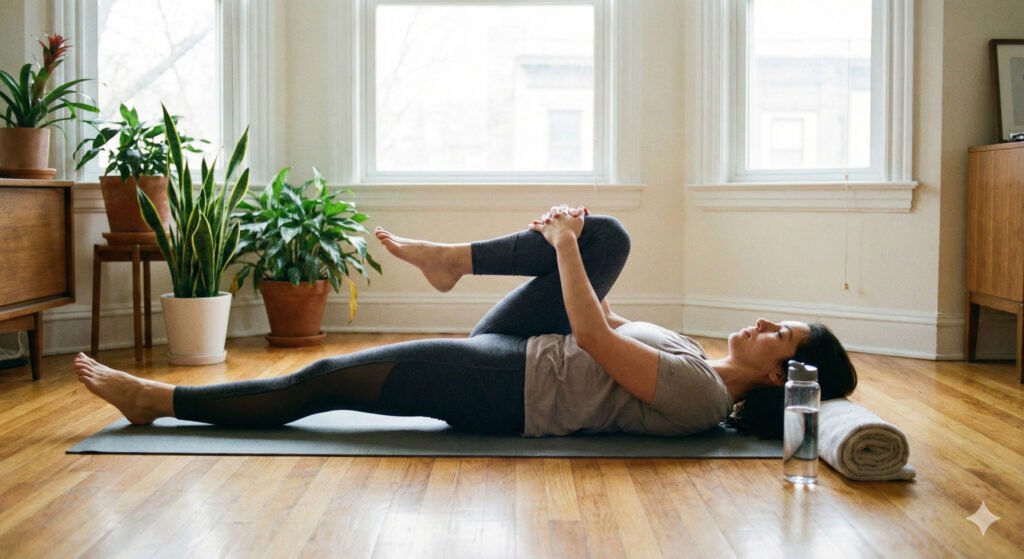
If comfortable, you may try drawing both knees to the chest together for a stronger stretch, but avoid this if it increases pain.
Bridge Exercise
The bridge strengthens the glutes, hamstrings, and core, all of which support the lower back.
-
Lie on your back with knees bent and feet flat, hip-width apart, arms by your sides.
-
Press through your heels and squeeze your glutes to lift your hips off the floor until your shoulders, hips, and knees form a straight line.
-
Hold for 5 seconds, then slowly lower your hips back down.
-
Perform 10–15 repetitions, resting briefly between reps.
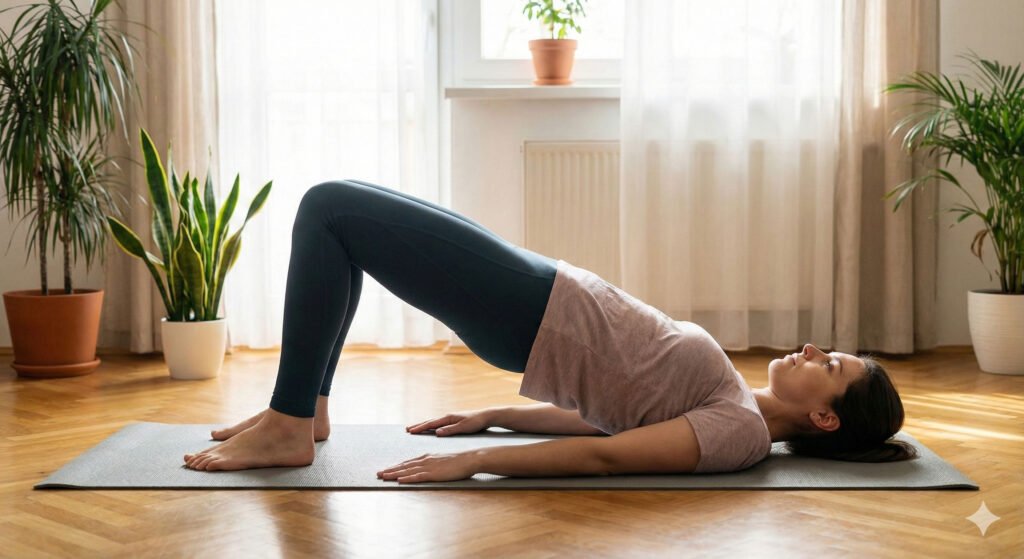
Over time, stronger glutes reduce strain on the lumbar spine during walking, climbing stairs, or lifting.
Intermediate Physiotherapy Exercises for Strength and Stability
Once your pain has decreased and the beginner exercises feel easy, you can progress to movements that challenge balance and core stability. These help prepare your body for more demanding activities.
Bird-Dog Exercise
The bird-dog is excellent for building core stability without excessive spinal loading.
-
Start in a tabletop position on hands and knees.
-
Extend your right arm forward and your left leg straight back, keeping hips level and spine neutral.
-
Hold for about 5 seconds, then slowly return to starting position.
-
Repeat with the opposite arm and leg, performing 10–15 repetitions per side.
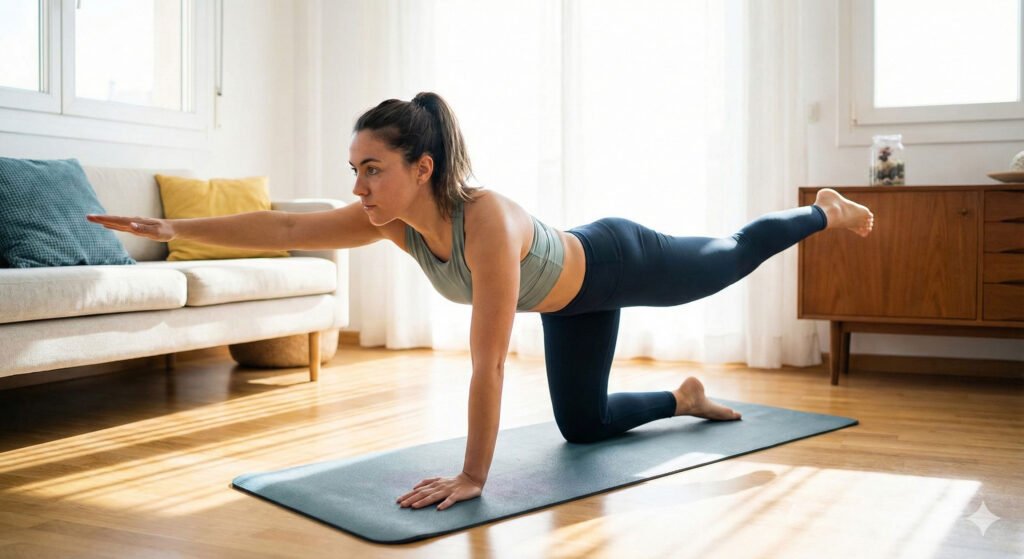
This exercise trains your back and core to stabilize the spine while your limbs move, which is essential for daily tasks.
Standing Hamstring Stretch
Tight hamstrings can pull on the pelvis and contribute to lower back strain.
-
Stand tall and place one heel on a low step or sturdy surface, keeping the knee slightly bent.
-
Gently hinge forward from the hips, keeping your back straight, until you feel a stretch along the back of your thigh.
-
Hold for 20–30 seconds and repeat 2–3 times per leg.
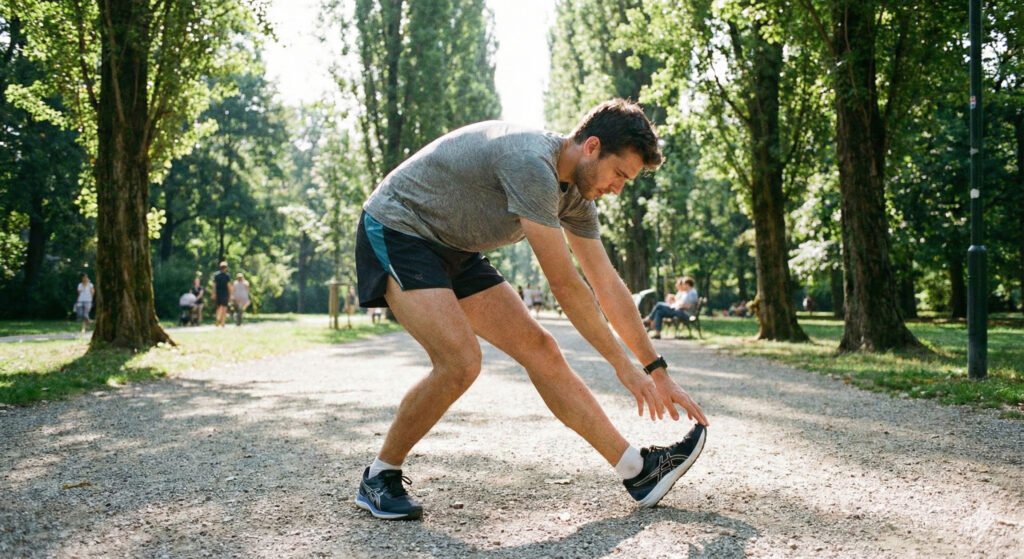
Improving hamstring flexibility often reduces tension in the lower back, especially in people who sit for long periods.
Lower Back Rotation Stretch
This stretch targets deeper muscles around the lower spine and hips.
-
Lie on your back with both knees bent and feet flat.
-
Gently let both knees drop to one side while keeping your shoulders on the floor until you feel a comfortable stretch.
-
Hold for 20–30 seconds, then bring your knees back to the center and repeat on the other side.
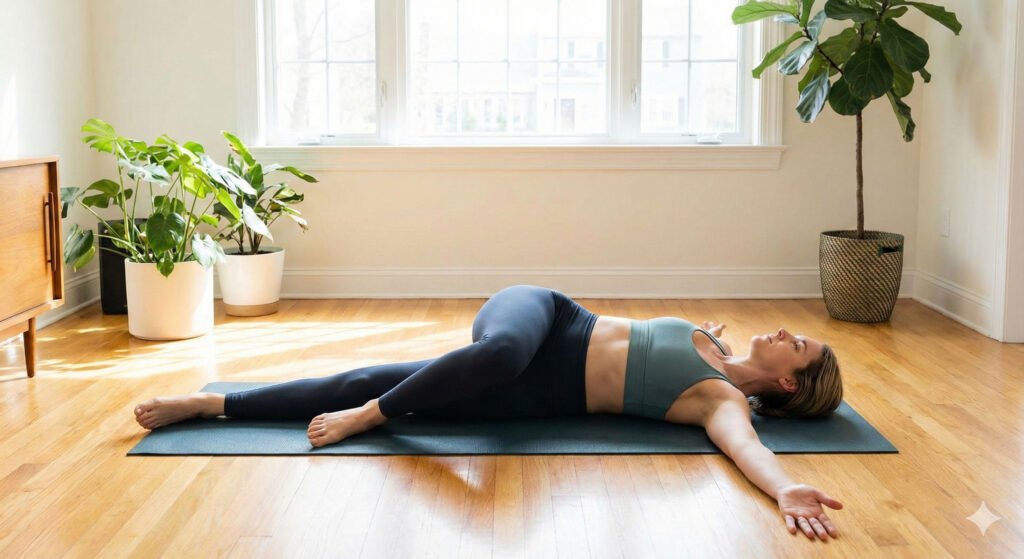
Perform 3–5 repetitions, avoiding any jerking or forcing the movement beyond a gentle stretch.
Wall Sits
Wall sits build endurance in the thighs and glutes, which support the pelvis and lower back.
-
Stand with your back against a wall, feet about hip-width apart and slightly forward.
-
Slide down into a sitting position with knees bent around 90 degrees, keeping your lower back gently against the wall.
-
Hold for 10–30 seconds, then push through your heels to stand up.
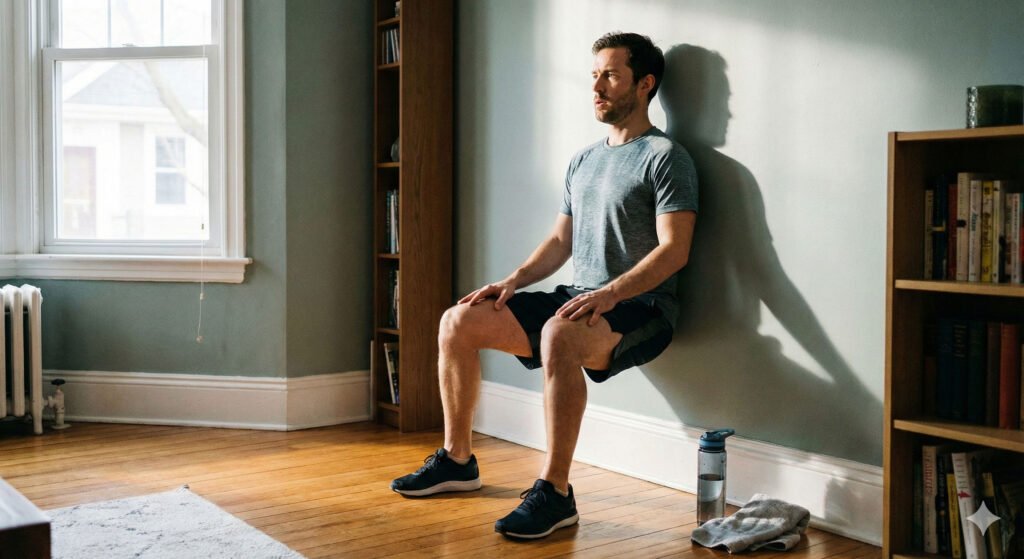
Repeat 3–5 times, increasing the hold duration gradually as your strength improves.
Common Mistakes and Exercises to Avoid
Many people try to fix lower back pain with random gym workouts or videos, which sometimes makes symptoms worse. For instance, doing heavy weightlifting or deep forward bends too early can overload sensitive structures.
Additionally, holding your breath, moving too fast, or pushing through sharp pain can lead to muscle spasms or further injury. Therefore, you should progress gradually, follow proper technique, and stop any exercise that significantly increases pain during or after the session.
When “No Pain, No Gain” Is Dangerous
The old “no pain, no gain” motto does not apply to lower back rehabilitation. Mild discomfort or stretching sensations are acceptable, but strong pain, especially if it radiates down the leg, is a sign to stop.
Furthermore, persistent pain that worsens over several days of exercise may indicate that the routine is not appropriate for your condition and requires professional adjustment.
Risky Exercises for Lower Back Pain
Unless supervised by a professional, avoid:
-
Heavy deadlifts or squats with poor form.
-
High-impact activities like repeated jumping or running on hard surfaces early in recovery.
-
Deep backbends or extreme twisting poses that compress the spine.
These movements can be beneficial for some people in later rehab stages but are not safe starting points for most individuals with active lower back pain.
When to See a Physiotherapist or Doctor
While many cases of mild lower back pain improve with structured exercises, some situations require an in-person assessment. Professional evaluation helps identify specific causes such as disc herniation, nerve compression, or sacroiliac joint issues.
If your pain persists beyond 4–6 weeks despite regular exercises, or if it keeps recurring in short cycles, a physiotherapist can analyze your movement patterns, posture, and muscle imbalances in more detail.
Red-Flag Symptoms You Should Not Ignore
Seek urgent medical care if you experience:
-
Sudden, severe lower back pain after trauma.
-
Loss of bladder or bowel control.
-
Numbness in the groin or inner thighs (saddle anesthesia).
-
Rapidly worsening leg weakness or numbness.
These symptoms may suggest serious conditions such as cauda equina syndrome and require immediate attention.
How a Physiotherapist Assesses Lower Back Pain
During an assessment, a physiotherapist will typically:
-
Take a detailed history of your pain onset, patterns, and aggravating or easing factors.
-
Assess posture, range of motion, muscle strength, and flexibility.
-
Perform specific tests to differentiate muscle, joint, and nerve involvement.
Based on the findings, they will design a tailored exercise program, teach correct technique, and progress your routine over time.
Step-by-Step Daily Routine (Sample Plan)
Below is a sample routine for mild to moderate non-specific lower back pain, assuming no red-flag symptoms.
Phase 1 (Week 1–2): Pain Relief and Mobility
-
Pelvic tilts: 10–15 reps, 1–2 sets.
-
Cat-cow: 10–15 reps, 1–2 sets.
-
Child’s pose: 3–5 holds of 20–30 seconds.
-
Knee-to-chest: 3 holds per leg, 20–30 seconds.
Perform once daily, or twice if pain is mild and you feel comfortable.
Phase 2 (Week 3–4): Early Strengthening
-
Continue Phase 1 exercises.
-
Add bridges: 10–15 reps, 2 sets.
-
Add standing hamstring stretch: 2–3 holds per leg, 20–30 seconds.
Phase 3 (Week 5+): Stability and Endurance
-
Maintain stretching routine as needed.
-
Add bird-dog: 10–15 reps per side, 2–3 sets.
-
Add wall sits: 3–5 holds of 15–30 seconds.
Adjust the progression based on pain levels and energy, and seek professional help if pain significantly increases or does not improve over time.
FAQs on Physiotherapy Exercises for Lower Back Pain
How often should I do physiotherapy exercises for lower back pain?
For most people with mild to moderate lower back pain, performing exercises 1–2 times per day during the early phase is appropriate, then reducing to 3–4 sessions per week for maintenance.
How long does it take to see results?
Many people notice some pain relief within 2–4 weeks of consistent exercise, although chronic cases may require several months of regular practice.
Can I do these exercises during a pain flare-up?
Gentle movements such as pelvic tilts, cat-cow, and short walks are often safe during mild flare-ups, but intense strengthening should be paused if pain is severe.
Are these exercises enough, or do I need other treatments?
Exercises form the core of most evidence-based back pain programs, but posture correction, ergonomics, weight management, and stress reduction also contribute to long-term relief.
Conclusion section
Lower back pain can be frustrating, but it is not something you have to accept as a permanent part of life. By incorporating targeted physiotherapy exercises such as pelvic tilts, cat-cow, bridges, bird-dog, and gentle stretches, you can strengthen key muscles, improve flexibility, and reduce the load on your spine. Over time, this combination of mobility and stability work helps not only to relieve current symptoms but also to reduce the risk of future flare-ups.
However, consistency matters more than perfection, so it is better to perform a short, well-chosen routine most days than to exercise intensively only once in a while. As you progress through the beginner and intermediate physiotherapy exercises for lower back pain, listen carefully to your body, increase difficulty gradually, and avoid any movement that causes sharp or worsening pain. In addition, paying attention to posture, work ergonomics, sleep, and stress can further enhance the benefits of your exercise program.
If your pain persists beyond several weeks, keeps coming back, or is accompanied by red-flag symptoms such as significant weakness, numbness, or bladder changes, do not rely on home exercises alone. Instead, consider booking a consultation with a qualified physiotherapist or spine specialist, who can provide a detailed assessment and design a plan tailored to your specific needs.
Use this guide as a starting point to understand the best physiotherapy exercises for lower back pain and to build a safe, effective routine you can follow at home. Share this post with someone who often complains about their back, and encourage them to start moving towards a stronger, more resilient spine today.
Check this
Best Physiotherapy Clinics in Guwahati → /guwahati/physiotherapy-clinics
lower back pain specialists in Guwahati → /guwahati/orthopedic-doctors
ergonomic office setup tips → /blog/ergonomic-office-setup-lower-back-pain
home workout guide for beginners → /blog/beginner-home-workout-routine
when to visit a diagnostic center for back pain → /guwahati/diagnostic-centers
Read More
